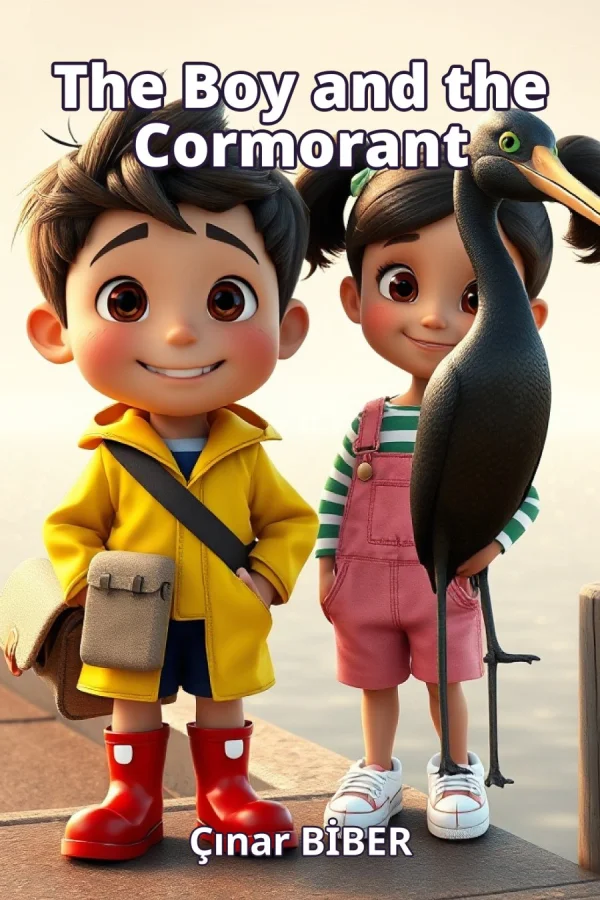
The Boy and the Cormorant
Çınar BİBER
- Category Children's Fairy Tales
- Format PDF
- Size 10.3 MB
- Added 30.10.2026
- Views 3
Leo loves the harbor more than anywhere else in the world. Every morning he pulls on his yellow raincoat and red rubber boots, takes his canvas satchel and small notebook, and runs down to watch the seabirds. One bird stands out on an old wooden post: a glossy black cormorant with a hooked beak and bright emerald eyes. Leo sits very still so he will not scare it away, and when the bird dives into the gray, sparkly sea and comes up with a silver fish, he writes his first question in his notebook: how does it do that?
His little sister Maya, in pink overalls and puffy black pigtails, asks to help, and together they return to the harbor to watch the cormorant more closely. Step by step they work out what they are seeing: webbed feet that push like paddles, a sleek body that slips through the water, wet feathers that make the bird heavy enough to sink, and emerald eyes that see in the dark and murky sea. Leo records each discovery in drawings and notes, and when Maya suggests building a model that swims, the two of them set to work with a plastic bottle, black paper, cardboard, old flip-flops and a small flashlight. Their model sinks, kicks and glows just like the real bird, and Leo decides to show it to everyone at the harbor festival.
The story follows a curious boy who turns patient observation into understanding, and a younger sister whose questions push his thinking further. It shows young readers how scientists work: watch closely, ask questions, write down what you see, test your ideas with a model, then explain them to others. It is suited to children at the picture-book and early-reader stage, and to anyone who enjoys a quiet story about the sea, seabirds and the pleasure of finding out how something works.
Read the Tale
If the PDF does not appear, open it in a new tab.
A Passage from the Tale
The Boy and the Cormorant Çınar BİBER
Every morning, a boy named Leo pulled on his bright yellow raincoat and red rubber boots. He grabbed his canvas satchel with his small notebook inside. Then he ran down to the harbor to watch the seabirds. The sea was gray and sparkly, and the air smelled like salt and fish. Leo loved the harbor more than anywhere else in the world. 1
One bird stood out on the old wooden post. It was a cormorant, glossy black with a bronze sheen in the sun. Its long hooked beak looked like a fishing hook, and its bright emerald eyes watched the water carefully. Leo thought it was the most wonderful bird he had ever seen. He sat very still so he would not scare it away. 2
The cormorant stretched its neck, tilted its body, and splash! It dove into the sea. Leo leaned forward and held his breath. Under the water, the bird swam fast, its webbed feet pushing like little paddles. In a flash, it caught a silver fish and popped back up. Leo wrote in his notebook: Dives deep. Catches fish. How does it do that? 3
At home, Leo's little sister, Maya, bounced into the kitchen in her pink overalls. "What are you writing?" she asked, her two puffy black pigtails swinging. Leo showed her his notebook. "I'm studying cormorants," he said. "They dive underwater to catch fish, and I want to know how." Maya's big brown eyes went wide. "Can I help?" she asked with a gap-toothed smile. 4
The next day, they went back to the harbor together. Leo pointed at the cormorant on the post. "Watch its feet," he whispered. The bird dove again, and its webbed feet kicked quickly. "Its feet are like flippers!" Maya said. Leo nodded and drew a picture of the webbed foot in his notebook. "That helps it swim fast," he said. "But there's more to learn." 5
They watched the cormorant swim low in the water. Its body was long and sleek, like a little torpedo. "Why does it sit so low?" Maya asked. Leo thought hard. "Its feathers get wet," he said. "Wet feathers make it heavy, so it can dive down easily." He wrote in his notebook: Heavy feathers help it sink. Different from ducks! Maya clapped her hands. "It's like a submarine!" 6
Leo noticed something else. The cormorant's eyes were bright emerald green. "Its eyes must see really well underwater," he said. "The water is dark and murky, but it still catches fish." Maya pretended to peer through the water. "I can't see anything!" she giggled. Leo laughed too. "That's why it has special eyes," he said. "Its body is built for hunting under the sea." 7
Back home, Leo spread his drawings on the kitchen table. He had pictures of the webbed feet, the sleek body, the hooked beak, and the bright eyes. "I want to show everyone how the cormorant dives," he said. Maya climbed onto a chair. "Make a model!" she said. "A model that swims!" Leo's hazel eyes lit up. "That's a great idea, Maya!" 8
Leo found an old plastic bottle for the body and black paper for the feathers. He cut a long beak from cardboard and painted it dark. Maya helped glue on the webbed feet, made from old flip-flops. "This is fun!" she said, her gap-toothed smile shining. Leo added a thin silver band around one leg, just like the real cormorant wore. "Now it looks just like our bird," he said. 9
Next, Leo built a clear plastic tank to show the diving. He filled it with water and added a toy fish on a string. "Watch this," he told Maya. He placed the model cormorant on the water. It floated low, just like the real bird. Then Leo gently pushed it down, and the model sank. "See? The wet feathers make it heavy," he explained. 10
Maya frowned. "But how does it swim fast?" she asked. Leo showed her the webbed feet on the model. He pulled a string, and the feet kicked back and forth. The model zoomed through the water toward the toy fish. "The webbed feet push the water," Leo said. "And the sleek body slips through easily." Maya clapped. "It really works!" she cheered. 11
Leo thought of one more thing. He added a tiny flashlight to the model's head to show the special eyes. "The cormorant can see underwater even when it's dark," he said. He turned on the light, and it glowed through the murky water. "Wow!" Maya gasped. "It's like a superhero bird!" Leo grinned. "Every part of its body helps it hunt," he said. 12
On Saturday, Leo set up his model at the harbor festival. He put a sign that said: How a Cormorant Dives. People stopped to watch. Leo pushed the model down, and it sank. He pulled the string, and the webbed feet kicked. The little light glowed. "The cormorant has special adaptations," Leo explained. "That means its body is built for its own way of life." 13
A fisherman nodded. "I've seen those birds dive a hundred times," he said. "But I never knew how they did it." Maya stood beside Leo, handing out little cards with drawings of the cormorant's feet and beak. "Different birds have different tricks," she said proudly. Leo smiled at his sister. Her questions had helped him explain everything so clearly.
This is a preview taken from the tale (about 912 words). To continue, read the tale or download the PDF.
Tale Details
- Tale
- The Boy and the Cormorant
- Author
- Çınar BİBER
- Category
- Children's Fairy Tales
- Language
- English
- Format
- PDF · 10.3 MB
- Pages
- 18
- Words
- about 1,040
- Published
- Masalcı Baba · 30.10.2026
- Access
- Free to read and download; for personal use only, all rights belong to the author.
Frequently Asked Questions
Is the PDF of The Boy and the Cormorant free?
Yes. The Boy and the Cormorant can be read and downloaded for free on this site; no sign-up or payment is required.
How many pages is The Boy and the Cormorant?
The Boy and the Cormorant has 18 pages and about 1,040 words.
Where can I read The Boy and the Cormorant?
It opens inside your browser on phones, tablets and computers; you can also download the PDF and open it offline.
Who wrote The Boy and the Cormorant?
The author of The Boy and the Cormorant is Çınar BİBER; the tale is in the Children's Fairy Tales category.