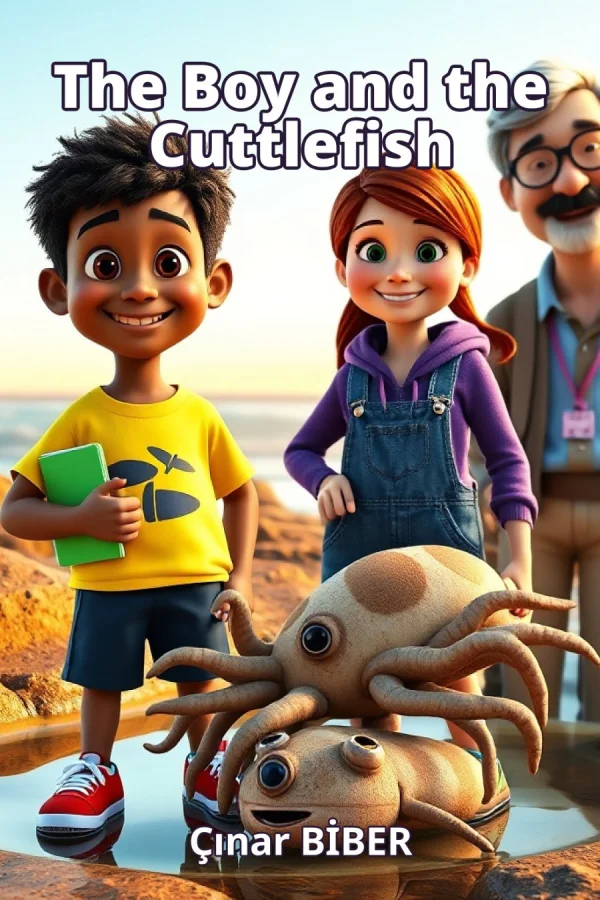
The Boy and the Cuttlefish
Çınar BİBER
- Category Children's Fairy Tales
- Format PDF
- Size 12.2 MB
- Added 30.10.2026
- Views 2
Leo is a curious boy who loves the sea and keeps a green notebook full of the things he notices along the rocky shore. One afternoon he spots a cuttlefish in a tide pool and watches, amazed, as its skin shifts from sandy beige to sea green to mottled brown. Its W-shaped pupils and soft oval body with eight arms and two longer tentacles fascinate him, and he decides to visit the creature every day after school to learn everything he can about it.
At school, Leo tells his teacher, Mr. Lee, about what he has seen, and learns the word for it: camouflage. With the science fair coming up, Mr. Lee suggests Leo study camouflage for his project. Leo teams up with his best friend Mia, and together they photograph the cuttlefish against sand, seaweed and rocks and fill his notebook with careful notes. At home, Leo gathers cardboard, paint, small LED lights and a battery pack to build his own color-changing model, working at the kitchen table for days while Mia helps with colored paper and glue.
On science fair day, Leo presents his model cuttlefish, switching the lights so it blends into each background in turn, and explains to the crowd that the real animal uses tiny muscles in its skin. The story shows young readers how close observation, patient note-taking and a simple circuit can turn a walk by the sea into a real investigation, and it gently reminds them that good ideas often come from nature. It is suited to children who are curious about sea creatures and to anyone looking for a warm story about curiosity, friendship and sharing what you have learned.
Read the Tale
If the PDF does not appear, open it in a new tab.
A Passage from the Tale
The Boy and the Cuttlefish Çınar BİBER
Leo was a boy with warm brown skin, short curly black hair, and large dark brown eyes. He loved the sea more than anything. Every afternoon, he ran to the rocky shore with his green notebook tucked under one arm. He wore his favorite bright yellow T-shirt with a blue fish print. The ocean waves whispered secrets, and Leo listened. 1
One day, Leo saw something amazing in a tide pool. A cuttlefish about thirty centimeters long floated near the rocks. Its soft oval body had wavy fins and eight arms plus two longer tentacles. Its large eyes had strange W-shaped pupils. Leo watched as the cuttlefish's skin shifted from sandy beige to sea green to mottled brown. He gasped. 2
Leo opened his green notebook and wrote: 'Cuttlefish changes color!' He drew the cuttlefish and its W-shaped pupils. The creature seemed to look right at him, then blended into the seaweed. Leo smiled. 'How do you do that?' he whispered. He decided to learn everything about this clever animal. He visited the cuttlefish every day after school. 3
At school, Leo told his teacher, Mr. Lee, about the cuttlefish. Mr. Lee had short gray-streaked black hair, thin round glasses, and a neat mustache. He wore a brown cardigan and a science fair lanyard. 'That's called camouflage,' Mr. Lee said. 'Animals use it to hide. The science fair is coming up. Maybe you could study camouflage?' Leo's eyes lit up. 4
Leo rushed to tell his best friend, Mia. She was taller than Leo, with light tan skin, long straight auburn hair in a ponytail, bright green eyes, and a wide friendly grin. She wore a purple hoodie and denim overalls. 'A science fair project about a color-changing fish?' Mia asked. 'That's cool!' Leo nodded. 'It's a cuttlefish,' he said. 'And it's not a fish—it's a mollusk!' 5
Leo and Mia went to the shore with a waterproof camera. They took photos of the cuttlefish as it changed colors. Leo wrote notes in his green notebook. The cuttlefish turned sandy beige on the sand, sea green near the seaweed, and mottled brown by the rocks. 'It's like magic,' Mia said. Leo grinned. 'No, it's science!' 6
Back at home, Leo thought about how to make his own colorchanging model. He wanted something that could blend into different backgrounds, just like the cuttlefish. He gathered cardboard, paint, small LED lights, and a battery pack. He worked at the kitchen table for days. His small gap-toothed smile grew wider with each new idea. 7
Mia came over to help. She brought colored paper and glue. 'How will it change colors?' she asked. Leo explained, 'I'll use lights and a simple circuit. When I switch it on, the lights will make the model look different.' They built a cuttlefish shape from cardboard and covered it with a special see-through material. Leo painted patterns on it. 8
The science fair day arrived. The school gym was full of colorful projects. Leo set up his booth with Mia's help. He placed his model cuttlefish on a small stand. Behind it, he put three backgrounds: sand, seaweed, and rocks. Mr. Lee walked by and smiled. 'I can't wait to see your demonstration,' he said. Leo felt proud and a little nervous. 9
Finally, it was Leo's turn to present. He turned on his model, and the cuttlefish's colors shifted to match the sandy background. Then he switched it, and the model turned sea green to blend with the seaweed. Finally, it became mottled brown to match the rocks. The crowd gasped. 'How does it do that?' a girl asked. Leo explained, 'It's camouflage, just like the real cuttlefish.' 10
Mia cheered the loudest. 'That's my friend Leo!' she shouted. Mr. Lee clapped and said, 'Nature inspires technology. You've shown us all how clever ideas can come from the sea.' Leo felt his cheeks grow warm. He looked at his model and then at the pictures of the cuttlefish. He felt happy and proud of his hard work. 11
The other kids crowded around Leo's booth. They asked questions and wanted to try the switches. Leo let them. 'This is amazing!' said a boy with glasses. 'Can you make it change faster?' asked another. Leo laughed and showed them how the lights worked. He explained that the real cuttlefish uses tiny muscles in its skin to change color. 'Someday I'll invent something even better,' he said. 12
At the end of the fair, Mr. Lee gave Leo a ribbon for 'Most Creative Use of Nature's Ideas.' Leo's eyes sparkled. He hugged his green notebook. Mia gave him a high-five. 'You did it!' she said. Leo looked at the ribbon and then at his model. He knew that the cuttlefish had taught him something important: nature is full of clever solutions. 13
That night, Leo dreamed of the cuttlefish. He saw its W-shaped pupils and wavy fins. He dreamed of inventing more things inspired by nature: a backpack that changes color like a chameleon, a swimsuit that moves like a dolphin, and a house that stays cool like a termite mound. His imagination swam in a sea of colors. 14
The next morning, Leo went back to the shore with his green notebook. He sat on the rocks and watched the waves. He thought about the cuttlefish and smiled. He knew that the ocean still held many secrets. He opened his notebook and wrote: 'New idea: learn from nature.' He couldn't wait to explore more.
This is a preview taken from the tale (about 924 words). To continue, read the tale or download the PDF.
Tale Details
- Tale
- The Boy and the Cuttlefish
- Author
- Çınar BİBER
- Category
- Children's Fairy Tales
- Language
- English
- Format
- PDF · 12.2 MB
- Pages
- 18
- Words
- about 983
- Published
- Masalcı Baba · 30.10.2026
- Access
- Free to read and download; for personal use only, all rights belong to the author.
Frequently Asked Questions
Is the PDF of The Boy and the Cuttlefish free?
Yes. The Boy and the Cuttlefish can be read and downloaded for free on this site; no sign-up or payment is required.
How many pages is The Boy and the Cuttlefish?
The Boy and the Cuttlefish has 18 pages and about 983 words.
Where can I read The Boy and the Cuttlefish?
It opens inside your browser on phones, tablets and computers; you can also download the PDF and open it offline.
Who wrote The Boy and the Cuttlefish?
The author of The Boy and the Cuttlefish is Çınar BİBER; the tale is in the Children's Fairy Tales category.