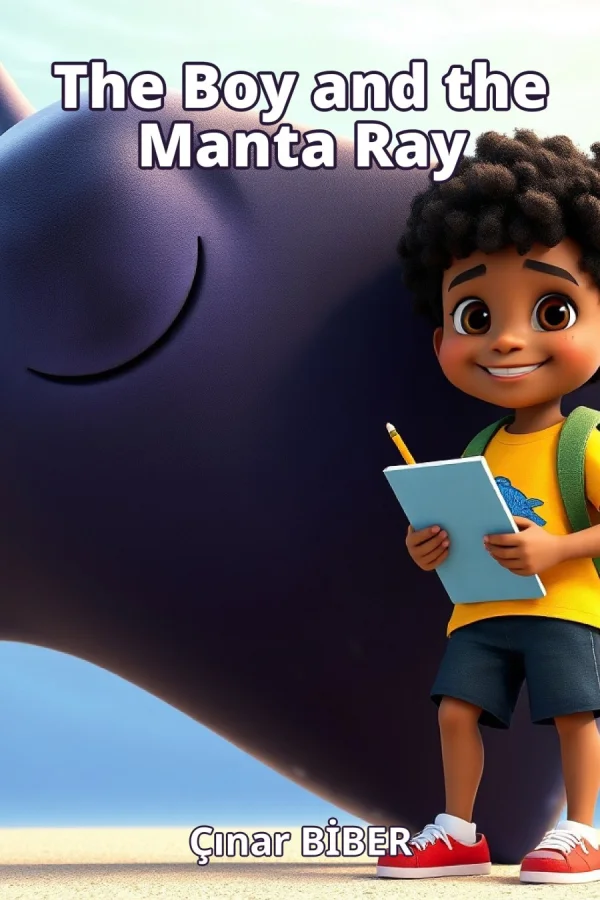
The Boy and the Manta Ray
Çınar BİBER
- Category Children's Fairy Tales
- Format PDF
- Size 10.4 MB
- Added 30.10.2026
- Views 1
Leo loves the ocean more than anything. Every Saturday he packs his green canvas backpack with snacks and his sketchbook and races to the beach with his mom, and at home his room is a small museum of ocean wonders, with posters of whales, dolphins and sea turtles, a jar of sea glass and a shelf of library books about marine wildlife. His best friend Maya shares his curiosity, and one afternoon at the beach Leo's wish comes true: a huge, gentle manta ray glides into the shallow water and circles him slowly, so close that he can see its dark back, white belly patches and friendly eyes. He stands very still, whispers to it, and quickly sketches its diamond shape and long thin tail before it returns to deeper water.
When Leo tells his mom about the encounter, she explains that manta rays are special but face real dangers such as fishing nets and pollution. Shocked that such peaceful creatures could be harmed, Leo visits the library to learn more and discovers that manta rays are gentle giants that eat tiny plankton, can grow wider than a car and live for many years, yet swallow plastic and get tangled in fishing gear. He decides to do something about it: with Maya's help he paints a bright poster full of facts and simple tips like keeping the ocean clean and saying no to plastic bags. The poster travels from the refrigerator to the classroom, the hallway and finally the school entrance, and Leo and Maya present it to their classmates and answer their questions.
The story follows a curious, observant boy who turns a moment of wonder into a small act of advocacy, and it shows young readers how affection for nature can grow into responsibility. It is written for children in the early primary years and for anyone reading aloud with them, offering a gentle introduction to marine life, ocean conservation and the idea that even a child's drawing can teach others something new.
Read the Tale
If the PDF does not appear, open it in a new tab.
A Passage from the Tale
The Boy and the Manta Ray Çınar BİBER
Leo loved the ocean more than anything. Every Saturday, he packed his green canvas backpack with snacks and his sketchbook, then raced to the beach with his mom. He loved the salty air, the crashing waves, and the treasure hunt of finding seashells. But most of all, Leo loved learning about the animals that lived beneath the waves. 1
At home, Leo's room was a museum of ocean wonders. Posters of whales, dolphins, and sea turtles covered his walls. He had a jar of smooth sea glass and a shelf full of library books about marine wildlife. Every night, he read about a new creature and drew it in his sketchbook. His mom said his eyes sparkled like the sea itself. 2
One sunny morning, Leo's best friend Maya came over. She wore her orange hoodie and a little turtle pin on her collar. 'What are you reading about today?' she asked, plopping down beside him. Leo showed her a picture of a manta ray with wings like a giant kite. 'They're huge but gentle,' he said. 'I wish I could see one for real.' 3
That afternoon, Leo and his mom went to the beach. He grabbed his sketchbook and pencil, hoping to draw some seabirds. The waves rolled in, and the sky was bright blue. Suddenly, a dark shape moved under the water. Leo held his breath. Was it a shark? No—it was a huge, flat diamond gliding gracefully toward the shore. 4
The creature swam closer, and Leo saw its wide wings ripple like underwater wings. It was a manta ray! Its back was dark blue-black, and its belly was white with pale patches on its shoulders. Small eyes peeked forward, and its broad mouth looked almost like a smile. Leo's heart raced with excitement. 5
The manta ray seemed curious about Leo. It swam in slow, gentle circles near the shallow water. Leo stood very still, his toes in the wet sand. 'Hello, beautiful,' he whispered. The ray's wingtip broke the surface, and sunlight danced on its dark back. For a moment, the boy and the giant fish looked right at each other. 6
Leo remembered his sketchbook. With quick, careful strokes, he drew the manta ray's diamond shape and long thin tail. He drew the friendly eyes and the white belly patches. 'You're amazing,' he said softly. The ray lingered a little longer, as if it knew it was being admired, then glided back into deeper water. 7
That evening, Leo told his mom everything. 'It was so big and so gentle!' he said, his gap-toothed smile wide. Mom smiled and said, 'Manta rays are special, but they need our help. Many face dangers like fishing nets and pollution.' Leo's eyebrows furrowed. 'But they're so peaceful. Who would hurt them?' 8
The next day, Leo went to the library to learn more. He read that manta rays are gentle giants that eat tiny plankton. They can grow wider than a car and live for many years. But he also learned that they get tangled in fishing gear and swallow plastic. 'That's terrible,' Leo thought. 'Someone should tell everyone.' 9
Leo had an idea. He would make a poster about manta rays! He ran home and pulled out a big sheet of paper. He painted a giant manta ray with wide wings and a friendly face. Around it, he wrote facts and tips: 'Keep the ocean clean!' and 'Say no to plastic bags!' He used bright colors—blue, green, and yellow. 10
The next day, Maya came over to help. She colored the poster's border with a rainbow of markers. 'Manta rays are like underwater birds,' she said. 'They fly through the sea!' Leo nodded. 'And they need our help to stay safe,' he said. Together, they added a drawing of a manta ray with a heart above it. 11
When the poster was finished, Leo showed it to his mom. She beamed with pride. 'This is wonderful, Leo! You've taught me something new.' She hung it on the refrigerator and took a photo to share with family. 'Can we show it at school?' Leo asked. 'Of course,' Mom said. 'Let's ask your teacher.' 12
At school, Leo and Maya presented their poster to the class. Leo explained how manta rays are gentle and smart, and how we can protect them by recycling and using reusable bags. His classmates asked questions and cheered. The teacher hung the poster in the hallway for everyone to see. Leo felt ten feet tall. 13
Soon, the poster became famous! Other classes came to look at it. The principal asked Leo to make a bigger one for the school entrance. Leo and Maya worked together, painting a giant manta ray with a message: 'Save the Ocean, Save the Rays!' They added fun facts and tips for everyone to read. 14
That weekend, Leo's family visited the beach again. He stood at the water's edge, hoping to see his manta ray. The sun sparkled on the waves, and suddenly, a familiar dark shape glided past. Leo waved. 'Thank you!' he whispered. He knew that even a small boy with a poster could help make a difference for the ocean. 15
Leo's poster taught his friends and family how to protect the ocean. They started using fewer plastic bags and picked up trash at the beach. Leo learned that even kids can help wildlife. He kept drawing in his sketchbook, dreaming of more adventures. And every time he saw a manta ray in his dreams, he smiled.
This is a preview taken from the tale (about 932 words). To continue, read the tale or download the PDF.
Tale Details
- Tale
- The Boy and the Manta Ray
- Author
- Çınar BİBER
- Category
- Children's Fairy Tales
- Language
- English
- Format
- PDF · 10.4 MB
- Pages
- 18
- Words
- about 933
- Published
- Masalcı Baba · 30.10.2026
- Access
- Free to read and download; for personal use only, all rights belong to the author.
Frequently Asked Questions
Is the PDF of The Boy and the Manta Ray free?
Yes. The Boy and the Manta Ray can be read and downloaded for free on this site; no sign-up or payment is required.
How many pages is The Boy and the Manta Ray?
The Boy and the Manta Ray has 18 pages and about 933 words.
Where can I read The Boy and the Manta Ray?
It opens inside your browser on phones, tablets and computers; you can also download the PDF and open it offline.
Who wrote The Boy and the Manta Ray?
The author of The Boy and the Manta Ray is Çınar BİBER; the tale is in the Children's Fairy Tales category.