The Boy and the Moth
Çınar BİBER
- Category Children's Fairy Tales
- Format PDF
- Size 11.3 MB
- Added 30.10.2026
- Views 2
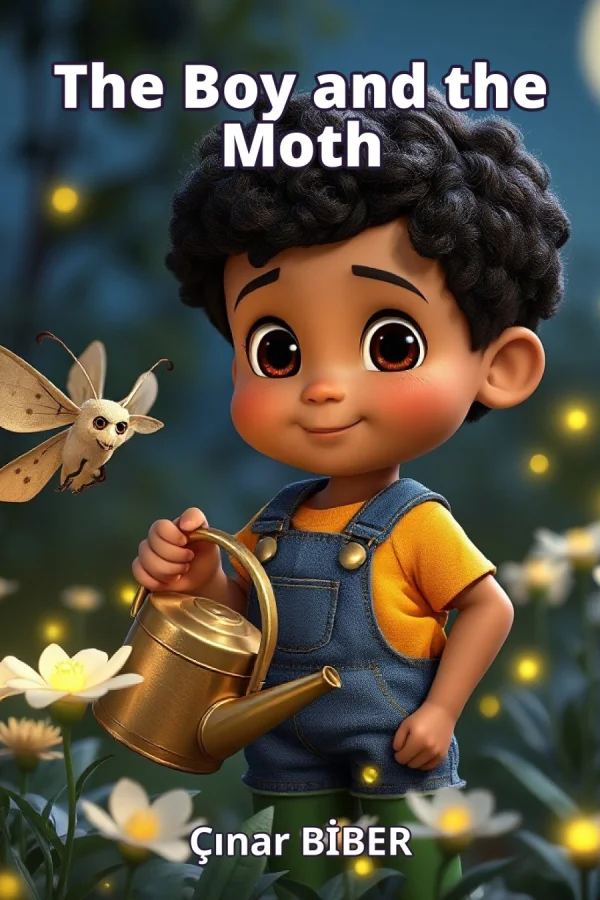
Leo loves his garden more than anything. Every morning he pulls tiny weeds and waters each flower with his little brass-handled watering can, wearing his yellow shirt, blue overalls and green boots that squelch in the soft dirt. But at night the garden feels quiet and empty, and Leo wonders whether anything happens out there after dark. One warm evening he sits very still on the back steps and discovers a dusty-cream moth with feathery antennae hovering beside a pale flower, sipping something sweet and leaving a dusting of golden sparkle behind.
Curious, Leo returns the next evening and watches the moth move from bloom to bloom, carrying pollen on its fuzzy body. An old book from the shed teaches him that moths, fireflies and beetles pollinate at night, and that many night flowers open after sunset and glow softly. With his mother's help he chooses seeds for evening primrose, moonflower and fragrant nicotiana, then waters and waits and watches for the first green sprouts. When the first moonflower finally opens like a tiny lantern, the moth returns with companions, and fireflies rise from the tall grass to blink among the glowing blossoms.
The story follows a young gardener who turns an empty evening garden into a busy nighttime world, and it shows readers that even the smallest, most overlooked creatures have important work to do. Quiet, gentle and full of observation, it suits young children being read to at bedtime as well as early readers ready for a longer picture-book story, and it offers a simple first look at pollination and night-blooming plants.
Read the Tale
If the PDF does not appear, open it in a new tab.
A Passage from the Tale
The Boy and the Moth Çınar BİBER
Leo loved his garden more than anything. Every morning he pulled tiny weeds and gave each flower a drink from his little brass-handled watering can. He wore his yellow shirt and blue overalls, and his green boots squelched in the soft dirt. But at night, Leo's garden felt quiet and empty. He often wondered, “Does anything happen out here after dark?” 1
One warm evening, Leo sat very still on the back steps, watching the sky turn from pink to deep blue. The flowers folded their petals and the air grew cool. “Goodnight, garden,” he whispered. Just then, something small and soft flickered near the pale flowers by the fence. Leo leaned closer, his dark brown eyes wide. “What was that?” 2
It was a moth! Its dusty-cream wings were patterned with soft grey-brown lines, and its fuzzy body looked like a tiny velvet pillow. Feathery antennae waved as it hovered beside a pale flower that glowed in the moonlight. Leo held his breath. The moth dipped its head into the blossom, sipped something sweet, and drifted to the next flower, leaving a dusting of golden sparkle. 3
The next evening, Leo waited by the fence, quiet as a mouse. The moth came back! It floated from bloom to bloom, its wings whispering. “You like this flower,” Leo murmured. “Why do you visit at night?” He watched the moth carry pollen on its fuzzy body, moving from one blossom to another. It was doing a job— a pollinator’s job—right under the moon. 4
Leo hurried to the shed and found an old book about night creatures. He read by flashlight, turning the pages slowly. “Moths, fireflies, and beetles pollinate at night,” he read aloud. “Many night flowers open after sunset and glow softly.” Leo’s heart thumped. “My garden could be a nighttime garden!” he said. “I can plant flowers that bloom in the dark!” 5
In the morning, Leo told his mom about his plan. “A moonlit garden!” he said, his quick smile flashing. She helped him choose seeds for flowers that open at night: pale evening primrose, moonflower, and fragrant nicotiana. Leo dug little holes and tucked each seed in, patting the soil gently. “Wait until you see,” he whispered to the seeds. “You’re going to light up the night!” 6
Every day, Leo watered his seeds with his brass watering can. He watched the soil, hoping for green sprouts. “Come on, little seeds,” he sang. “The moth is waiting!” At last, tiny leaves pushed through the dirt. Leo clapped his hands. “You did it!” he cheered. His freckled nose wrinkled with happiness as he watered each new sprout. 7
Weeks passed, and the plants grew taller. One evening, Leo noticed pale buds on the moonflower vine. “They’re almost ready,” he told his mom. “But what if the moth doesn’t come back?” She smiled. “Patience, little gardener. The night has a way of surprising us.” Leo sat on the steps, watching the buds glow faintly in the moonlight, and waited. 8
Then, on a soft summer night, the first moonflower opened. It was big and white, glowing like a tiny lantern. The evening primrose opened too, and the nicotiana sent a sweet perfume into the air. Leo gasped. “It’s beautiful!” He didn’t have to wait long. The dusty-cream moth appeared, its feathery antennae twitching. It floated to the moonflower and sipped, just like before. 9
Other tiny visitors came too! A second moth with pink and yellow wings arrived. A third with patterned brown wings joined them. Leo sat perfectly still. “You brought your friends,” he whispered to the first moth. “Welcome to the night garden!” The moths drifted from flower to flower, their fuzzy bodies dusted with golden pollen. The garden had never felt so alive. 10
Then, from the tall grass, a soft yellow-green glow blinked on and off. Fireflies! They drifted up like tiny stars, their little black bodies glowing. One landed on Leo’s finger, flickered twice, and flew off. “Hello, little lanterns,” Leo laughed. Soon the whole garden sparkled. The fireflies danced around the glowing flowers, and the moths sipped sweet nectar. The night was busy and bright. 11
Leo brought his mom outside to see. “Look!” he whispered. Fireflies blinked around the silver moonflowers, and moths hovered near the pale blossoms. “You made this happen,” she said softly. Leo shook his head. “We made it happen. The flowers, the moths, the fireflies—we all helped.” He looked at his garden with new eyes. It wasn’t empty at all. It was full of tiny, important workers. 12
Leo learned something special that night. Even the smallest, most overlooked creatures have important jobs to do. The moth pollinates the flowers while everyone sleeps. The fireflies light the way. “You’re all helpers,” Leo said. “I’m glad I noticed you.” He sat quietly, watching the night shift work together. His garden wasn’t just for him anymore. It was for the whole moonlit world. 13
After that, Leo spent many evenings in his night garden. He kept a little notebook and drew the moths and fireflies. He counted five kinds of moths and dozens of fireflies. “Every night is an adventure,” he told his mom. “The garden is like a secret party, and I’m invited!” He felt proud that he had made a home for the tiny night visitors. 14
One evening, his friend Maya came to visit. “Why do you sit out here in the dark?” she asked. Leo pointed. “Watch,” he said. A moth settled on a moonflower, and fireflies blinked around it. Maya’s eyes grew wide. “They’re pollinating!” Leo nodded. “Even at night, the garden is busy. Little creatures do big jobs.” Maya smiled.
This is a preview taken from the tale (about 954 words). To continue, read the tale or download the PDF.
Tale Details
- Tale
- The Boy and the Moth
- Author
- Çınar BİBER
- Category
- Children's Fairy Tales
- Language
- English
- Format
- PDF · 11.3 MB
- Pages
- 18
- Words
- about 1,031
- Published
- Masalcı Baba · 30.10.2026
- Access
- Free to read and download; for personal use only, all rights belong to the author.
Frequently Asked Questions
Is the PDF of The Boy and the Moth free?
Yes. The Boy and the Moth can be read and downloaded for free on this site; no sign-up or payment is required.
How many pages is The Boy and the Moth?
The Boy and the Moth has 18 pages and about 1,031 words.
Where can I read The Boy and the Moth?
It opens inside your browser on phones, tablets and computers; you can also download the PDF and open it offline.
Who wrote The Boy and the Moth?
The author of The Boy and the Moth is Çınar BİBER; the tale is in the Children's Fairy Tales category.