The Boy and the Osprey
Çınar BİBER
- Category Children's Fairy Tales
- Format PDF
- Size 12.0 MB
- Added 30.10.2026
- Views 1
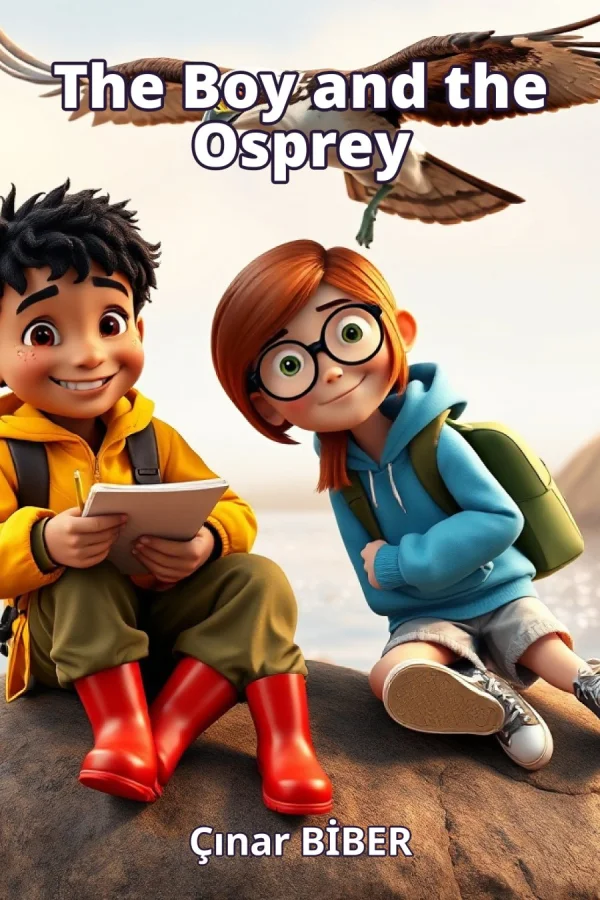
Every morning, a boy in a mustard-yellow rain jacket and red rubber boots walks to the river near his home to watch the ospreys, the large fishing birds that soar above the water and plunge feet-first to catch fish. With a sketchbook and pencil in his satchel, he sits on a flat rock and begins a nature journal, drawing the osprey on its stick nest and writing down what he observes: how the bird dives, how it shakes water from its feathers, how many fish it catches, and why it needs clear water to see its prey.
When his friend, a girl with round glasses and a green backpack, asks what he is doing, the boy shares his journal with her. Together they test the river water in a jar, look for small fish in the shallows, and talk about how clean water connects the river, the fish and the birds. Their curiosity grows into action: they make a poster reading 'Clean water = happy ospreys!', bring the journal to their classmates, and organize a river clean-up day with friends and families, filling bags with litter along the banks.
The story follows a child who learns by watching closely, writing down facts and sharing what he finds. It introduces young readers to ospreys and to the idea that rivers, fish and birds depend on one another, and it shows how small, practical steps such as picking up trash or telling others can help. It is suited to children beginning to explore nature, animals and simple environmental care, and to adults reading alongside them.
Read the Tale
If the PDF does not appear, open it in a new tab.
A Passage from the Tale
The Boy and the Osprey Çınar BİBER
Every morning, a boy in a mustard-yellow rain jacket and red rubber boots walked to the river near his home. He loved to watch the ospreys, the big fishing birds that soared high above the water. With his sketchbook and pencil tucked in his satchel, he sat quietly on a flat rock, waiting. He had warm brown skin, curly black hair, and a bright, curious grin that never faded. 1
The osprey was a magnificent bird, with a wingspan as wide as a grown-up's arms. Its dark brown back and wings contrasted with a white head and underparts. Sharp yellow eyes scanned the water below, and its hooked black beak was ready to catch a fish. The boy watched as it hovered in the air, then plunged feet-first into the river. Splash! It rose with a silver fish in its talons. 2
The boy decided to start a nature journal. On the first page, he drew the osprey perched on a tall nest of sticks. He wrote: 'Ospreys are fishing birds. They eat fish. They need clean water to see their prey.' He noted how clear the river looked that day, sparkling like glass. He wanted to learn everything about these amazing birds. 3
Each day, the boy added to his journal. He drew the osprey diving, its wings folded back like a arrow. He wrote about the way it shook water from its feathers after a catch. He noted the size of the fish it caught and how many dives it made. His sketchbook filled with drawings and facts, all written in his careful handwriting. 4
One afternoon, the boy's friend came to visit. She had light tan skin, straight auburn hair, and round glasses. She wore a skyblue hoodie and carried a green backpack. 'What are you doing?' she asked, peering over his shoulder. The boy showed her his journal. 'I'm studying ospreys,' he said. 'They're the best fishers in the river!' 5
The friend listened eagerly as the boy explained. 'Ospreys need clean water,' he said. 'If the river is dirty, they can't see the fish, and they go hungry.' He flipped through the pages, showing her his drawings. 'Look at this one—it's catching a fish bigger than its head!' The friend's eyes widened behind her glasses. 6
The friend asked, 'How do you know the water is clean?' The boy pointed to the river. 'See how clear it is? I can see the stones at the bottom. That means it's healthy.' He showed her a page where he had drawn the river with little ripples and fish swimming. 'When the water is clean, the fish are healthy, and the ospreys are healthy too.' 7
The boy and his friend decided to test the water. They filled a jar with river water and let it settle. The boy wrote in his journal: 'The water is clear. No mud or trash.' They saw small fish darting in the shallows. 'The ospreys have plenty to eat here,' the boy said. 'But not all rivers are like this.' 8
The friend had an idea. 'Let's make a poster about keeping rivers clean,' she said. They drew an osprey diving and wrote: 'Clean water = happy ospreys!' They hung it on the fence near the river. Other kids stopped to look. The boy felt proud. He knew that even small actions could help. 9
That evening, the boy watched the osprey again. It sat on its nest, tearing at a fish. He drew the scene carefully. He wrote: 'Ospreys are predators. They need healthy rivers with lots of fish.' He thought about how everything was connected—the water, the fish, the birds. It was like a big, beautiful puzzle. 10
The next day, the boy brought his journal to school. He showed his classmates the drawings of ospreys and the clear river. 'These birds need our help,' he said. 'We can keep the river clean by not littering and by telling others.' His friend nodded. 'We can all be river heroes!' she added. The class cheered. 11
The boy and his friend organized a river clean-up day. They invited their friends and families. Everyone wore gloves and carried bags. They picked up trash along the banks. The boy found a plastic bottle and wrote in his journal: 'This could hurt the fish and the ospreys.' They filled three big bags with litter. 12
After the clean-up, the boy sat by the river and watched an osprey soar. It circled high, then dove and caught a fish. He smiled. His journal was full of notes and pictures, but the best part was sharing what he learned. He knew that clean water helped the ospreys, and that people could make a difference. 13
The friend came over and looked at the journal. 'You should show this to more people,' she said. 'Maybe we can make copies.' The boy nodded. They spent the afternoon drawing extra pictures and writing simple facts. They made a small booklet titled 'Ospreys Need Clean Rivers.' They gave copies to their neighbors and friends. 14
On the last page of his journal, the boy drew a big osprey with a fish in its talons, flying over a sparkling river. He wrote: 'Healthy rivers support predators. When we take care of the water, we take care of the ospreys too.' He closed the journal, feeling happy. He couldn't wait to see what he would discover next.
This is a preview taken from the tale (about 912 words). To continue, read the tale or download the PDF.
Tale Details
- Tale
- The Boy and the Osprey
- Author
- Çınar BİBER
- Category
- Children's Fairy Tales
- Language
- English
- Format
- PDF · 12.0 MB
- Pages
- 18
- Words
- about 977
- Published
- Masalcı Baba · 30.10.2026
- Access
- Free to read and download; for personal use only, all rights belong to the author.
Frequently Asked Questions
Is the PDF of The Boy and the Osprey free?
Yes. The Boy and the Osprey can be read and downloaded for free on this site; no sign-up or payment is required.
How many pages is The Boy and the Osprey?
The Boy and the Osprey has 18 pages and about 977 words.
Where can I read The Boy and the Osprey?
It opens inside your browser on phones, tablets and computers; you can also download the PDF and open it offline.
Who wrote The Boy and the Osprey?
The author of The Boy and the Osprey is Çınar BİBER; the tale is in the Children's Fairy Tales category.