The Boy and the Sea Otter
Çınar BİBER
- Category Children's Fairy Tales
- Format PDF
- Size 10.5 MB
- Added 30.10.2026
- Views 2
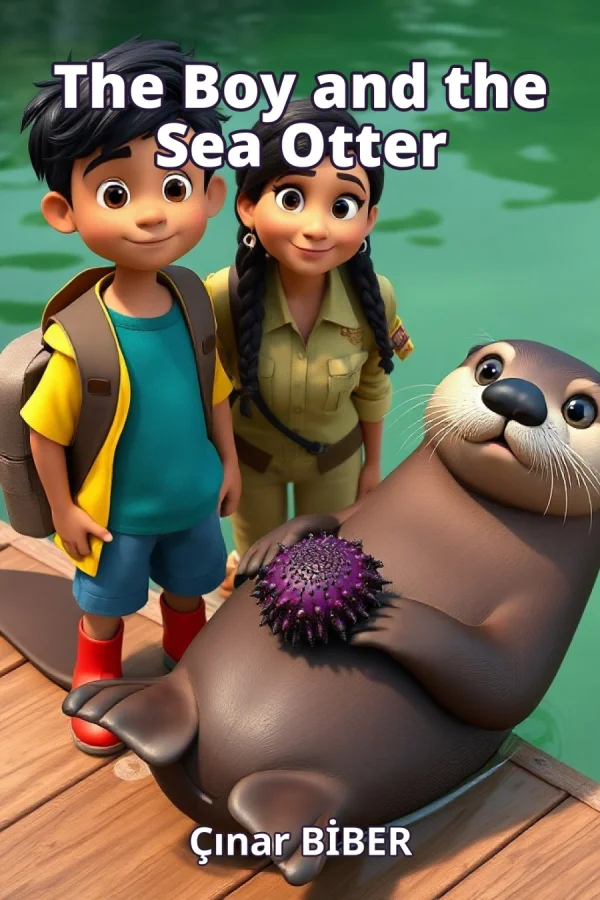
Eight-year-old boy with a notebook and a stub of pencil stands at the edge of a dock, hoping to see something wonderful. Ranger Mira rows him out over a kelp forest, where long brown stalks rise from the sea floor like trees and fish and crabs move among the leaves. There he meets a sea otter floating on its back, cracking open a sea urchin on its chest, and begins to fill his notebook with what he observes.
As the boy draws the kelp, the spiny urchins, the otter, the fish and the crab, Mira explains why one stretch of rock lies bare and gray: too many urchins can strip a kelp forest down to an urchin barren. The otter, she says, keeps the urchins in check, and plenty of kelp means shelter for many ocean animals. Following her questions, the boy draws arrows between the creatures and works out a food web, discovering that every animal has a job and that the whole forest depends on every piece.
The story is written for young children and for the adults who read with them. It introduces the idea of interdependence in nature through a single small animal that helps without knowing it, and it ends with the boy adding one more arrow to his page, from himself to the ocean, marked TAKE CARE. Readers learn how scientists observe and record, what a kelp forest is, and why quiet, steady help matters.
Read the Tale
If the PDF does not appear, open it in a new tab.
A Passage from the Tale
The Boy and the Sea Otter Çınar BİBER
The boy stood at the edge of the dock and pulled his yellow rain jacket tight. Below him, the water was green and clear and full of swaying shadows. He was eight years old, small and wiry, with short wavy black hair and freckles across his nose. In his satchel he carried a notebook and a stub of pencil. Today he wanted to see something wonderful. 1
Ranger Mira met him with a wide smile. She was tall and sturdy, with a thick black braid and silver hoop earrings, and her wide-brim sun hat shaded her warm hazel eyes. "Ready for the kelp forest?" she asked. The boy nodded fast. "I have a notebook," he said. "Good," said Mira. "Scientists write down what they see." 2
They rowed out in a little boat, and soon the boy saw it: a whole forest under the water. Long brown kelp stalks rose from the sea floor, waving like trees in the wind. Fish darted between the leaves, and crabs picked their way along the rocks below. "It's a real forest," the boy whispered. "It's home for hundreds of ocean animals," said Mira. 3
Mira stopped rowing and pointed. "Look there." A sea otter floated on its back, sleek dark fur shining, its thick tail curled up like a pillow. It held a spiky sea urchin on its chest and turned it in its webbed paws. Then crack, crunch, it began to eat. The boy leaned over the side and watched with round dark eyes. 4
"He's hungry," the boy said. "Very," said Mira, laughing. "Sea otters eat lots of sea urchins every single day, because urchins are crunchy and full of food." The otter rolled over once, then went back to its snack. The boy pulled out his notebook. He drew a quick picture of an otter holding an urchin like a tiny round snack. 5
Mira held out her binoculars. "Now look down, near the kelp stalks." The boy looked. Sea urchins clung to the kelp, round purple-black bodies with long thin spines. They moved slowly on tiny tube feet. "They eat kelp," Mira said. "See how they nibble? They graze it like sheep in a meadow." The boy wrote KELP in big letters. 6
Then he saw something odd. One stretch of the rocks was bare and gray, with no kelp at all. "Why is that part empty?" he asked. Mira nodded slowly. "Good question. Where there are too many urchins, they eat and eat. They strip the kelp forest bare. That empty place is called an urchin barren." The boy stared at it, frowning. 7
"So the urchins can eat everything?" asked the boy. "They could," said Mira. "But something keeps them in check. Out here, the sea otter is the hero." The boy looked at the floating otter again, busy and playful, cracking open another urchin. "One small animal protects all this?" he asked. "One small animal," said Mira, "keeps the whole forest growing." 8
The boy turned the pages of his notebook. He drew the kelp first, as tall as trees. Then he drew the urchins, spiky and slow, clinging to the stalks. Then he drew the otter, floating on its back with a snack on its chest. "They're all connected," he said. "I think," said Mira, "you're making a food web. That's what scientists do." 9
He added a fish, silver and quick, hiding in the kelp leaves. He added a crab, scurrying on the rocks. He drew arrows between them, showing who eats what. The kelp feeds the urchins. The urchins feed the otter. The kelp gives shelter to the fish and the crabs. His pencil raced across the page. "Every animal has a job," he said. 10
Mira laughed warmly. "That's exactly right." She tapped the sea otter. "He keeps the urchins in check. Not too many urchins means plenty of kelp. And plenty of kelp means shelter for fish and crabs and all the ocean animals." The boy looked at his model, and suddenly the whole kelp forest made sense. Every piece depended on every other piece. 11
The otter stretched and dove, sleek and quick, then popped back up and began to groom its fur. The boy smiled. "He doesn't even know he's helping everybody," he said. "That's the best kind of help," said Mira. "Quiet help. Steady help. Every day, without even knowing it." The green water swayed and shimmered all around them. 12
Then the boy noticed a change in his drawing. "If the otter left," he said slowly, "the urchins would grow and grow. They would eat the kelp and leave an empty place like that one." "True," said Mira. "So helping each other keeps the ocean happy and healthy. Species depend on one another. That's the secret of the kelp forest." 13
On the boat ride home, the boy held his notebook open on his knees. He added one more arrow, from himself to the ocean, and wrote beside it: TAKE CARE. Mira saw it and nodded. "Every choice we make matters," she said. The tide rocked the little boat gently, and the boy tucked his pencil safely inside his satchel. 14
That evening, he taped his food web to the wall above his bed. "Goodnight, kelp," he whispered. "Goodnight, urchins. Goodnight, otter." He touched the otter drawing last. One small, busy animal had shown him how the whole ocean holds together. He closed his round dark eyes and smiled.
This is a preview taken from the tale (about 920 words). To continue, read the tale or download the PDF.
Tale Details
- Tale
- The Boy and the Sea Otter
- Author
- Çınar BİBER
- Category
- Children's Fairy Tales
- Language
- English
- Format
- PDF · 10.5 MB
- Pages
- 18
- Words
- about 987
- Published
- Masalcı Baba · 30.10.2026
- Access
- Free to read and download; for personal use only, all rights belong to the author.
Frequently Asked Questions
Is the PDF of The Boy and the Sea Otter free?
Yes. The Boy and the Sea Otter can be read and downloaded for free on this site; no sign-up or payment is required.
How many pages is The Boy and the Sea Otter?
The Boy and the Sea Otter has 18 pages and about 987 words.
Where can I read The Boy and the Sea Otter?
It opens inside your browser on phones, tablets and computers; you can also download the PDF and open it offline.
Who wrote The Boy and the Sea Otter?
The author of The Boy and the Sea Otter is Çınar BİBER; the tale is in the Children's Fairy Tales category.