The Girl and the Koi
Çınar BİBER
- Category Children's Fairy Tales
- Format PDF
- Size 12.8 MB
- Added 30.10.2026
- Views 2
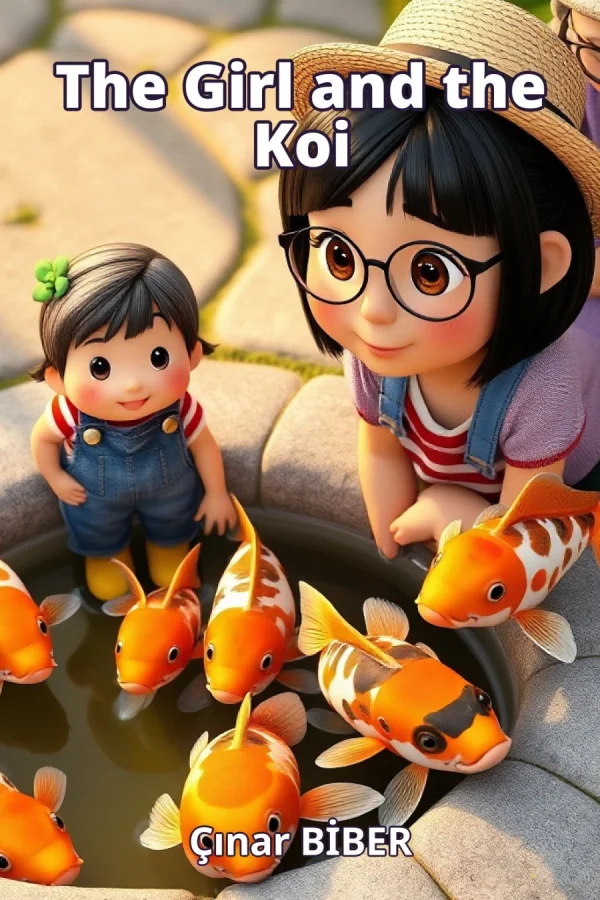
Mika is eight years old and loves the round, quiet pond at the bottom of Grandma Yuki's garden, where seven koi glide like slow orange ribbons. The biggest one, with a black spot on its head, she calls Spot. Every morning she runs down the path in her yellow rain boots to say hello, and one day Grandma Yuki kneels beside the water and begins to teach her what real care for the fish means: testing the water with a marked glass tube, feeding a little at a time, and writing each result in a small notebook.
Some days the work is slow and tiring. Mika scoops out fallen leaves, rinses the filter, checks the pump, and gets her boots muddy. When she asks whether she must do this every single day, Grandma Yuki reminds her that the koi cannot do these things for themselves; they can only swim and wait and trust. So Mika keeps coming, even on days when she would rather play. Then one morning the water turns cloudy and green, the koi stay low, and Spot barely rises for his food. Together grandmother and granddaughter test the water, scoop leaves, add fresh water, and shade part of the pond, and Mika learns that the slow part is where care truly lives.
This gentle children's tale follows one girl through a season of small daily responsibilities, showing young readers what patience, observation, and steady attention can do. It is suited to children of roughly six to nine years, to parents and grandparents reading aloud, and to anyone who wants a quiet story about noticing problems early and not giving up when the work is slow.
Read the Tale
If the PDF does not appear, open it in a new tab.
A Passage from the Tale
The Girl and the Koi Çınar BİBER
Mika loved the pond at the bottom of Grandma Yuki's garden. It was round and quiet, ringed with smooth grey stones and soft green moss. Inside the pond lived seven koi, gliding like slow orange ribbons. The biggest one had a black spot on its head, and Mika called it Spot. Every morning, Mika ran down the path in her yellow rain boots to say hello. 1
Mika was eight years old, with a black bob and bangs that tickled her eyebrows. Her green watering-can hair clip bounced as she walked. Grandma Yuki said the clip was perfect, because Mika was a little gardener of fish. Grandma Yuki wore her straw sun hat and thin round glasses, and she knew everything about ponds. "Come," she said one morning. "Let me show you how we care for them." 2
"Koi are strong," Grandma Yuki said, kneeling by the water, "but they need our help." She handed Mika a long glass tube with tiny marks on the side. "This tests the water," she explained. "Fish breathe the water, just like we breathe the air." Mika looked at Spot, who poked his round whiskered mouth above the surface. "So clean water keeps them happy?" she asked. "Clean water keeps them healthy," Grandma Yuki said. 3
The next morning, Mika came early with a small bucket of koi food. She sprinkled it gently across the surface, a little at a time. Spot rose first, his glossy orange-and-white scales shining, and the others followed like bright sparks. Their flowing fins waved softly as they ate. "Not too much," Mika whispered to herself, remembering Grandma Yuki's words. "A little every day is better than a lot once." 4
After feeding, Mika checked the water with the glass tube. She watched the tiny marks and wrote the number in a little notebook. Sometimes the water was clear and fine. Sometimes it looked cloudy, and she told Grandma Yuki right away. "Good girl," Grandma Yuki said, adjusting her lavender cardigan. "You noticed. That is the most important part of care — paying attention." Mika nodded and wrote the number down carefully. 5
Some days the work felt slow. Mika had to scoop out fallen leaves with a long net before they sank and turned the water murky. She had to rinse the filter and check the little pump that made gentle bubbles. Her arms grew tired, and her boots got muddy. "Do I have to do this every single day?" she asked one afternoon. "The fish depend on you," Grandma Yuki said softly. 6
Mika thought about Spot and the other six koi. They could not scoop leaves or check the water themselves. They could only swim and wait and trust. So Mika kept going. She came every morning, even on days when she wanted to play. She fed them, counted them, and wrote her numbers in the notebook. Slowly, the pond stayed clear, and the koi swam brightly. 7
One morning, Mika saw something worrying. The water looked a little green and cloudy, and the koi stayed low near the bottom. Spot barely came up for his food. Mika's small round face grew serious, and the freckles across her nose seemed to stand still. "Grandma Yuki!" she called. "Something is wrong with the water." Grandma Yuki came quickly, her straw hat tilted. 8
Together they tested the water. The number was not good. "Too much sun and too many leaves," Grandma Yuki said calmly. "We can fix this." Mika and Grandma Yuki worked side by side. They scooped the leaves, added fresh water, and shaded part of the pond with a small screen. It took the whole afternoon. Mika's arms ached, but she did not stop. "Almost there," she whispered to Spot. 9
For three days, Mika checked the water twice a day. She wrote every number in her notebook and fed the koi only a little. Grandma Yuki said, "This is the slow part. This is where care truly lives." Mika watched the koi rest quietly below. She worried, but she kept working. On the fourth morning, the water sparkled clear again. Spot rose to the surface and wiggled his whiskers at her. 10
The koi came up one by one, their orange, white, and black patches glowing in the sun. They swam in bright circles, fins flowing like silk. "They are saying thank you," Grandma Yuki laughed, her hazel eyes crinkling behind her glasses. Mika laughed too, and her watering-can clip bounced. "They look so happy!" she said. "They are healthy," Grandma Yuki said. "And that is because you never gave up." 11
Mika opened her little notebook and looked at all her numbers, page after page. Every day was there — the sunny days, the muddy days, the slow days. "It was a lot of days," she said. "Yes," said Grandma Yuki, putting a warm hand on Mika's shoulder. "Animal care is not one big day. It is many small days, one after another. That is consistency, and that is love." 12
From then on, Mika kept her morning routine. Feed the koi, scoop the leaves, test the water, write the number. Some days were quick and easy. Some days were slow and muddy. But Mika never skipped a morning, because seven bright friends were waiting for her. Spot always came first, his black head spot shining, and the others followed like a little parade of living jewels.
This is a preview taken from the tale (about 911 words). To continue, read the tale or download the PDF.
Tale Details
- Tale
- The Girl and the Koi
- Author
- Çınar BİBER
- Category
- Children's Fairy Tales
- Language
- English
- Format
- PDF · 12.8 MB
- Pages
- 18
- Words
- about 1,119
- Published
- Masalcı Baba · 30.10.2026
- Access
- Free to read and download; for personal use only, all rights belong to the author.
Frequently Asked Questions
Is the PDF of The Girl and the Koi free?
Yes. The Girl and the Koi can be read and downloaded for free on this site; no sign-up or payment is required.
How many pages is The Girl and the Koi?
The Girl and the Koi has 18 pages and about 1,119 words.
Where can I read The Girl and the Koi?
It opens inside your browser on phones, tablets and computers; you can also download the PDF and open it offline.
Who wrote The Girl and the Koi?
The author of The Girl and the Koi is Çınar BİBER; the tale is in the Children's Fairy Tales category.