The Girl and the Sea Urchin
Çınar BİBER
- Category Children's Fairy Tales
- Format PDF
- Size 12.1 MB
- Added 30.10.2026
- Views 3
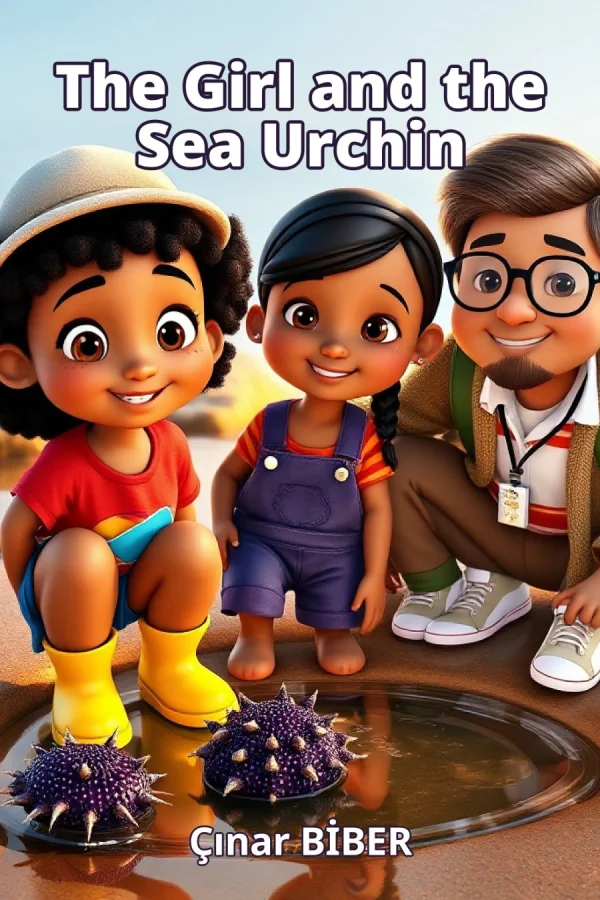
Mia loves the rocky shore near her home, and every morning she pulls on her yellow rain boots and races to the tide pools with her canvas bucket hat and fish-print shirt. One day she finds a purple sea urchin in a shallow pool and watches it quietly, wondering what it does all day. When her teacher Mr. Hale explains that sea urchins are grazers that scrape algae off rocks and keep the tide pool healthy, Mia begins to understand that even small creatures have important jobs.
Inspired, Mia and her best friend Priya decide to build a tide pool model with their class. The children shape clay rocks, paint a blue pool, and make seaweed, crabs, snails and several sea urchins, including one they name Spike. As they work, Mr. Hale explains the role of each animal: crabs are scavengers, snails scrape algae, and seaweed makes oxygen and gives shelter. When the seaweed keeps falling off the rocks, the class solves the problem together, and on presentation day the children proudly show their families what they have learned.
The story follows Mia and Priya as they discover how the creatures of the rocky shore depend on one another, and it shows young readers that cooperation and curiosity can turn a simple observation into a shared project. It is suited to children in the early school years, especially those who enjoy nature, animals and stories about friendship and working as a team.
Read the Tale
If the PDF does not appear, open it in a new tab.
A Passage from the Tale
The Girl and the Sea Urchin Çınar BİBER
Every morning, Mia pulled on her yellow rain boots and raced to the rocky shore. She loved the salty wind and the crash of waves. Her canvas bucket hat bobbed as she scrambled over rocks, and her red shirt with the little fish print flapped. Today the tide was low, and the tide pools sparkled like tiny oceans. 1
Mia knelt beside a shallow pool. Purple sea urchin! It looked like a round pincushion, its dark shell covered in thin spines. Tiny tube feet waved between the spines. Mia watched quietly, her dark eyes wide. "What do you do all day?" she whispered. The sea urchin didn't answer. It just stayed still, nibbling something on the rock. 2
At school, Mia told Mr. Hale about the sea urchin. He smiled, his round glasses glinting. "Sea urchins are grazers," he said. "They scrape algae off rocks. That keeps the tide pool healthy for other animals." Mia thought about the little urchin, quietly doing its job. "So even small creatures have big jobs?" she asked. Mr. Hale nodded. "Every species has a role." 3
That afternoon, Mia and her best friend Priya returned to the shore. Priya's long black braid swung as she peered into the pools. "Look, a crab!" she said. The crab scuttled sideways. "And snails!" Mia pointed to tiny shells stuck to the rocks. "And seaweed!" Priya added. "The tide pool is full of life," Mia said. "But how do they all work together?" 4
Mia had an idea. "Let's build a tide pool model in class," she told Priya. Priya's hazel eyes lit up. "I can bring supplies!" she said, adjusting her green backpack. The next day, they asked Mr. Hale. He clapped his hands. "What a wonderful way to learn!" he said. His shell keychain jingled as he leaned over. "Let's all work together." 5
The class gathered cardboard, clay, and paint. Mia painted a big blue pool. Priya mixed gray clay for rocks. Other kids made seaweed from green paper strips. "Don't forget the sea urchin," Mia said. She shaped a round purple body and stuck in tiny spines. "It looks just like Spike!" said Priya. Mia laughed. "Spike? That's a perfect name." 6
Mr. Hale explained more about the rocky shore. "Crabs are scavengers," he said. "They clean up dead things. Snails scrape algae, just like urchins. Seaweed makes oxygen and gives shelter." The children listened closely. "So everyone has a job," Mia said. "Exactly," said Mr. Hale. "Teamwork in nature." The class nodded and got back to work. 7
The model grew bigger and better. Priya organized the supplies neatly. She painted bright green seaweed and glued it to the rocks. Mia added tiny clay snails. Another friend made a crab with pipe-cleaner legs. "We need more urchins," Mia said. She made three more, each with careful spines. The tide pool model was coming alive. 8
Mia placed Spike gently in the center of the model pool. "You're the star," she said. Priya added a tiny label: "Sea Urchin—Grazer." The other kids added labels too. "Crab— Scavenger." "Snail—Algae Scraper." "Seaweed—Shelter and Oxygen." The classroom filled with excited voices. Mr. Hale smiled. "You're all learning so much," he said. 9
But then Mia noticed a problem. The seaweed kept falling off the rocks. "It won't stick," Priya said, frowning. The class tried glue, then tape. Nothing worked. "Maybe we can use clay to hold it," Mia suggested. Everyone tried. It worked! The seaweed stood up tall. "Teamwork makes big ideas come true," Mr. Hale said. The class cheered. 10
On presentation day, families came to see the rocky shore model. Mia stood proudly beside it. "This is Spike," she said, pointing to the purple urchin. "He eats algae to keep the pool clean. Crabs clean up, snails scrape, and seaweed gives shelter." Priya held up a chart. "Every animal has a role," she said. The parents clapped. Mia felt warm inside. 11
Mr. Hale gave each student a shell keychain like his own. "You've worked like real scientists," he said. Mia held her shell and smiled. She thought of Spike in his real tide pool, quietly grazing. "Nature learning is exciting," she said. Priya nodded. "And teamwork makes it fun!" The class agreed. They promised to visit the shore together soon. 12
That weekend, Mia and Priya returned to the rocky shore with their families. They found Spike's pool again. "He's still here!" Mia said. The sea urchin's spines swayed in the water. "He's doing his job," Priya said. Mia nodded. "Just like we did." They watched the crabs and snails too, knowing each one had a special role. The tide pool was a busy little world. 13
Mia brought her shell keychain to school every day. She loved telling others about the tide pool. "Did you know sea urchins have tiny feet?" she asked a younger kid. The kid's eyes went wide. "Really?" Mia nodded. "And they help keep the ocean clean." Mr. Hale overheard and smiled. "You're a teacher now, Mia," he said. Mia beamed. 14
The class decided to keep the model in the library. Mia wrote a sign: "The Rocky Shore—Every Animal Has a Job." Priya drew pictures of Spike and friends. Other kids added facts. Soon, the whole school came to see. "It's like a tiny ocean," one teacher said. Mia felt proud. Her small idea had grown into something big.
This is a preview taken from the tale (about 909 words). To continue, read the tale or download the PDF.
Tale Details
- Tale
- The Girl and the Sea Urchin
- Author
- Çınar BİBER
- Category
- Children's Fairy Tales
- Language
- English
- Format
- PDF · 12.1 MB
- Pages
- 18
- Words
- about 972
- Published
- Masalcı Baba · 30.10.2026
- Access
- Free to read and download; for personal use only, all rights belong to the author.
Frequently Asked Questions
Is the PDF of The Girl and the Sea Urchin free?
Yes. The Girl and the Sea Urchin can be read and downloaded for free on this site; no sign-up or payment is required.
How many pages is The Girl and the Sea Urchin?
The Girl and the Sea Urchin has 18 pages and about 972 words.
Where can I read The Girl and the Sea Urchin?
It opens inside your browser on phones, tablets and computers; you can also download the PDF and open it offline.
Who wrote The Girl and the Sea Urchin?
The author of The Girl and the Sea Urchin is Çınar BİBER; the tale is in the Children's Fairy Tales category.