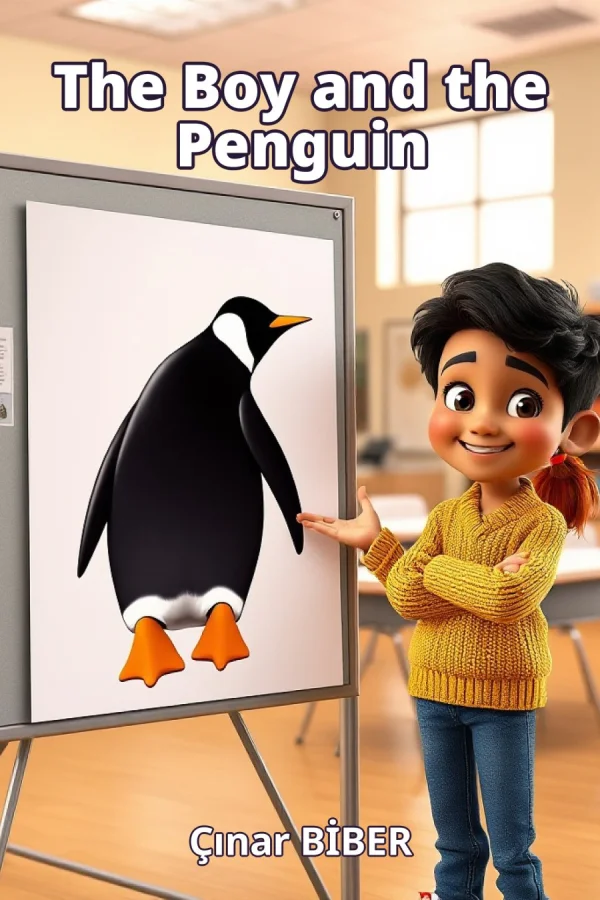
The Boy and the Penguin
Çınar BİBER
- Category Children's Fairy Tales
- Format PDF
- Size 11.9 MB
- Added 30.10.2026
- Views 2
Mateo is a young boy who has spent two weeks studying penguins, filling twelve pages of a canvas satchel with careful notes in his wobbly best handwriting. On a bright Monday morning he hurries to school in his mustard-yellow sweater, eager to share what he has learned. His teacher, Ms. Rivera, suggests he turn his research into a classroom exhibit and present it to his classmates, and Mateo throws himself into the work: drawing a penguin with a glossy black back and white belly, building a habitat from cotton-ball snow and a dish of icy water, and writing two important words in marker — WATERPROOF and WARM.
On Wednesday morning, with butterflies in his stomach, Mateo stands beside his exhibit and explains how penguin feathers work. A shiny piece of wax paper shows how water slides right off, and a cotton ball wrapped around his finger demonstrates how soft down traps heat like a blanket. When a classmate asks why the penguin needs all of this, Mateo answers that the bird lives where the wind is cold and the water is icy, and Ms. Rivera adds that animals are shaped by their environments.
The story follows a child who turns curiosity into patient research and then into something he can share with others, and it shows how preparation and a little courage can carry a young presenter through nervous moments. Young readers learn simple facts about penguin feathers, down and habitat, and they see a model of a student who reads, draws, builds and explains what he has discovered. It suits children in the early school years, parents reading aloud, and teachers looking for a gentle story about curiosity, effort and the satisfaction of teaching others something new.
Read the Tale
If the PDF does not appear, open it in a new tab.
A Passage from the Tale
The Boy and the Penguin Çınar BİBER
On a bright Monday morning, a boy named Mateo hurried to school with his canvas satchel bumping at his side. Inside the satchel were twelve pages of penguin notes, all written in his wobbly best handwriting. His mustard-yellow sweater glowed like a little sun as he ran. Today, he would finally share what he had learned about penguins with his class. 1
Mateo had studied penguins for two whole weeks. He read about their black backs, white bellies, and bright orange beaks. He learned that penguins live in icy habitats where snow falls and wind blows cold. But one fact amazed him most of all. Penguin feathers are waterproof, like tiny raincoats made of fluff. He could not stop thinking about it. 2
At school, Mateo found his teacher, Ms. Rivera, arranging books on a shelf. Her teal cardigan swished as she turned. “I finished my penguin research,” Mateo said, holding up his notes. Ms. Rivera smiled through her thin glasses. “Wonderful,” she said. “Would you like to build an exhibit and present it to the class?” Mateo nodded so fast his curly black hair bounced. 3
That afternoon, Mateo spread his notes across the kitchen table. He drew a penguin with a glossy black back, a white belly, and orange feet. Then he wrote one big word in blue marker: WATERPROOF. He had learned that tiny hooks hold each feather tight, so icy water slides right off. The penguin stays dry even after a long swim. 4
Next, Mateo wrote another word in orange marker: WARM. Under its waterproof feathers, a penguin has soft, fluffy down that traps heat like a cozy blanket. He drew little arrows showing warmth staying close to the penguin's body. “So the cold never sneaks in,” he whispered. He imagined the penguin standing snug in its snowy habitat, perfectly cozy. 5
On Tuesday, Mateo carried a big cardboard box to class. Inside were his drawings, a blue cloth for icy water, and cotton balls for snow. His red sneakers squeaked on the floor as he walked. Ms. Rivera cleared a table near the window and said, “This will be a wonderful spot for your exhibit.” Mateo's gap-toothed smile stretched wide across his round face. 6
Mateo painted a penguin on poster board, black on the back and white on the belly. He added a bright orange beak and two little orange feet. On its chest, he glued a shiny piece of wax paper. “This shows the waterproof feathers,” he explained to Ms. Rivera. She nodded and said, “I can see exactly how the water slides off.” 7
Then Mateo built the habitat. He piled cotton balls for snow and placed a small dish of water beside the penguin poster. He drew arrows pointing from the water toward the shiny wax paper. “The water cannot get through,” he told the empty classroom. “The feathers keep the penguin dry and warm.” He felt proud of every careful detail. 8
On Wednesday morning, Mateo's stomach fluttered with butterflies. He stood beside his exhibit while his classmates gathered around. His dark brown eyes looked at all the curious faces. Ms. Rivera gave him an encouraging nod. Mateo took a deep breath and began, “This is a penguin, and these are its special feathers. Let me show you how they work.” 9
Mateo pointed to the wax paper on the penguin's chest. “These feathers are waterproof,” he said. “When the penguin swims in icy water, the water rolls right off. It never soaks in.” He tilted the dish and let a little water drip onto the wax paper. The drops slid away, and the class gasped. “It stays dry!” a girl whispered. Mateo smiled proudly. 10
Next, Mateo lifted the cotton balls. “Under the waterproof feathers, there is soft down,” he said. “The down traps warmth close to the penguin's body, like a blanket.” He wrapped one cotton ball around his finger. “That is how a penguin stays cozy in its cold habitat.” His classmates leaned in closer to see. The whole room felt warm with wonder. 11
A boy near the back raised his hand. “Why does the penguin need all that?” he asked. Mateo answered right away. “Because of its habitat! It lives where the wind is cold and the water is icy. Its feathers are shaped for that place.” Ms. Rivera smiled and said softly, “Animals are shaped by their environments.” Mateo nodded, thinking hard about her words. 12
Mateo looked around the room. “Every animal has a special way to live where it does,” he said. “The penguin's waterproof feathers and warm down help it survive in the cold.” He touched his poster gently. “The penguin is clever and cozy, all at the same time.” His classmates clapped their hands. Someone cheered. Mateo's proud heart felt as warm as a penguin's down. 13
After the presentation, Ms. Rivera asked the class to share one thing they learned. Hands shot up like little flags. “Waterproof feathers keep penguins dry!” said one. “The down holds in warmth!” said another. Mateo listened with a wide smile. His small mole on his left cheek seemed to twinkle with joy. He had taught his whole class something wonderful. 14
That afternoon, Mateo sat by the window and watched snowflakes drift down outside. He thought of the penguin in its icy habitat, snug and dry and warm. “Waterproof feathers,” he whispered. “Warm down.” He added a new page to his notes, drawing the classroom exhibit with little stars around it. His short curly hair stuck up in happy tufts.
This is a preview taken from the tale (about 935 words). To continue, read the tale or download the PDF.
Tale Details
- Tale
- The Boy and the Penguin
- Author
- Çınar BİBER
- Category
- Children's Fairy Tales
- Language
- English
- Format
- PDF · 11.9 MB
- Pages
- 18
- Words
- about 995
- Published
- Masalcı Baba · 30.10.2026
- Access
- Free to read and download; for personal use only, all rights belong to the author.
Frequently Asked Questions
Is the PDF of The Boy and the Penguin free?
Yes. The Boy and the Penguin can be read and downloaded for free on this site; no sign-up or payment is required.
How many pages is The Boy and the Penguin?
The Boy and the Penguin has 18 pages and about 995 words.
Where can I read The Boy and the Penguin?
It opens inside your browser on phones, tablets and computers; you can also download the PDF and open it offline.
Who wrote The Boy and the Penguin?
The author of The Boy and the Penguin is Çınar BİBER; the tale is in the Children's Fairy Tales category.