The Boy and the Seahorse
Çınar BİBER
- Category Children's Fairy Tales
- Format PDF
- Size 11.5 MB
- Added 30.10.2026
- Views 3
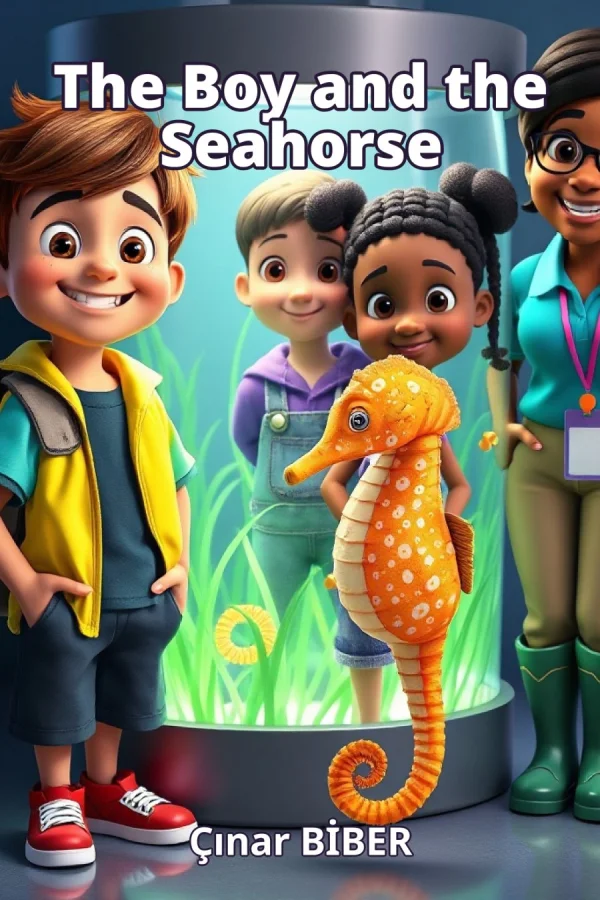
Leo is a curious boy with messy chestnut-brown hair and a notebook full of questions. One special day he pulls on his yellow rain jacket and visits the marine center with his friend Rosie, where Marina, a guide in an aqua-blue polo shirt, introduces them to a tiny golden-orange seahorse named Pip. Watching Pip curl his tail around a blade of seagrass, Leo learns that seahorses are shy creatures who depend on thick underwater meadows to hide from bigger fish and find their food. Marina explains that seagrass meadows work like underwater neighborhoods, sheltering small fish, crabs and baby sea creatures, and Leo carefully writes it all down.
When Marina admits that these meadows are shrinking because of pollution and careless boat anchors, Leo feels a tug at his heart and wonders what a kid can possibly do. With Rosie's encouragement, he turns his notebook into action, building a cardboard and clay model of a seagrass habitat and bringing it to his classroom. Standing before his classmates, he explains why small species need healthy homes and shares simple ways everyone can help, from picking up trash at the beach to never anchoring boats on seagrass.
The story follows a gentle, hopeful arc about curiosity turning into stewardship, and it shows young readers that knowledge shared with others can ripple outward. It is suited to children in early primary school, to parents and teachers looking for a read-aloud about ocean habitats, and to anyone who wants a quiet reminder that even the smallest creatures depend on the places we protect.
Read the Tale
If the PDF does not appear, open it in a new tab.
A Passage from the Tale
The Boy and the Seahorse Çınar BİBER
Leo pulled on his bright yellow rain jacket and grabbed his canvas satchel. Today was special: he was visiting the marine center to learn about seahorses. His messy chestnut-brown hair stuck up in tufts as he ran ahead. "Wait for me!" called his friend Rosie, her braids bouncing as she hurried to catch up. The ocean air smelled salty and fresh. 1
At the marine center, a tall woman with a friendly dimpled smile greeted them. Her aqua-blue polo shirt had a tiny seahorse logo. "Welcome! I'm Marina," she said, adjusting her round glasses. "Are you ready to meet some amazing ocean animals?" Leo nodded so hard his freckles seemed to dance. He opened his notebook, ready to write. 2
Marina led them to a glowing tank full of green seagrass swaying like a gentle forest. "Seahorses live here," she explained. Leo pressed his nose to the glass. Suddenly, he spotted a tiny golden-orange creature gripping a blade of grass. "Look!" he whispered. "It's a seahorse!" Its long snout and bright black eyes seemed to smile back. 3
"That's Pip," Marina said. "He's only about ten centimeters tall." Leo watched as Pip curled his tail around a seagrass stem. "Seahorses are shy," Marina continued. "They need thick seagrass to hide from bigger fish and to find tiny snacks." Leo wrote carefully: Seahorses need seagrass. He drew a little curly tail in the margin. 4
Marina showed Leo how seagrass meadows are like underwater neighborhoods. "Small fish, crabs, and baby sea creatures all find food and shelter here," she said. Leo's hazel eyes grew wide. "So seagrass is like a home for lots of animals?" he asked. "Exactly!" Marina smiled. "A healthy habitat keeps everyone safe." Leo scribbled fast, his pencil flying across the page. 5
But then Marina's smile faded a little. "Sadly, seagrass meadows are shrinking," she said. "Pollution and careless boat anchors can hurt them." Leo looked at Pip, who was now hiding deep in the grass. "What happens to seahorses if the seagrass goes away?" he asked. Marina sighed. "They have nowhere to hide or find food." Leo felt a tug at his heart. 6
On the way home, Leo couldn't stop thinking about Pip. "I want to help," he told Rosie. "But I'm just a kid. What can I do?" Rosie's brown eyes sparkled. "You could teach others!" she said. "Remember your notebook? You could build a model to show everyone why seagrass matters." Leo's gap-toothed smile grew wide. "That's a great idea!" 7
That afternoon, Leo spread out his supplies on the kitchen table. He used a cardboard box for the ocean floor and painted it sandy brown. Green crepe paper became swaying seagrass blades. He molded a tiny seahorse from orange clay, curling its tail just like Pip's. "This is going to be good," he whispered, his tongue poking out in concentration. 8
Leo added small shells, blue tissue paper for water, and a paper sun fish. He placed his clay seahorse right in the middle, gripping a green blade. Then he made a little sign: Seahorses need seagrass! His satchel hung on his chair, still holding his trusty notebook. "Almost done," he said, stepping back to admire his work. 9
The next day, Leo brought his model to show Rosie. Her eyes went wide. "Wow! It looks just like the tank at the marine center!" She pointed at the clay seahorse. "Is that Pip?" Leo nodded proudly. "I want to teach everyone that small species need healthy homes," he said. Rosie clapped her hands. "Let's show the whole class!" 10
At school, Leo stood in front of his classmates with his model. His heart thumped, but he took a deep breath. "This is a seagrass habitat," he began. "Seahorses like Pip hide here and find food. But seagrass is in trouble, and we can help by keeping the ocean clean." The room was silent, everyone listening. 11
Rosie raised her hand. "How can we help from here?" she asked. Leo smiled. "We can tell others, pick up trash at the beach, and never anchor boats on seagrass," he said. Marina, who had come to watch, nodded proudly. "Small actions make a big difference," she added. The class burst into applause. 12
Leo's teacher, Ms. Chen, asked him to leave the model on the science table for a week. "This is a wonderful way to learn," she said. Leo beamed. At recess, kids crowded around the model, asking questions. Leo explained how seagrass shelters baby fish and crabs, too. "Even the smallest creatures need a safe home," he told them. 13
That weekend, Leo and Rosie went back to the marine center. Marina showed them Pip again, still curled in the seagrass. "Your model taught so many people," she said. "Pip would be proud." Leo pressed his nose to the glass. "I'm going to keep learning about the ocean," he said. "And keep helping however I can." 14
Back at home, Leo added a tiny notebook to his model, just like his own. He wrote a new sign: Small species need healthy habitats! He placed it next to the clay seahorse. His yellow rain jacket hung by the door, ready for the next adventure. "The ocean is full of tiny heroes," he told Rosie. "And we can help them all." 15
Rosie smiled, her gap tooth showing. "You're a hero too, Leo," she said. "You taught us that even the smallest homes matter." Leo looked at his model and felt warm inside. He knew that every seagrass blade, every tiny seahorse, and every curious kid could make a difference. And that was the best feeling of all.
This is a preview taken from the tale (about 950 words). To continue, read the tale or download the PDF.
Tale Details
- Tale
- The Boy and the Seahorse
- Author
- Çınar BİBER
- Category
- Children's Fairy Tales
- Language
- English
- Format
- PDF · 11.5 MB
- Pages
- 18
- Words
- about 951
- Published
- Masalcı Baba · 30.10.2026
- Access
- Free to read and download; for personal use only, all rights belong to the author.
Frequently Asked Questions
Is the PDF of The Boy and the Seahorse free?
Yes. The Boy and the Seahorse can be read and downloaded for free on this site; no sign-up or payment is required.
How many pages is The Boy and the Seahorse?
The Boy and the Seahorse has 18 pages and about 951 words.
Where can I read The Boy and the Seahorse?
It opens inside your browser on phones, tablets and computers; you can also download the PDF and open it offline.
Who wrote The Boy and the Seahorse?
The author of The Boy and the Seahorse is Çınar BİBER; the tale is in the Children's Fairy Tales category.