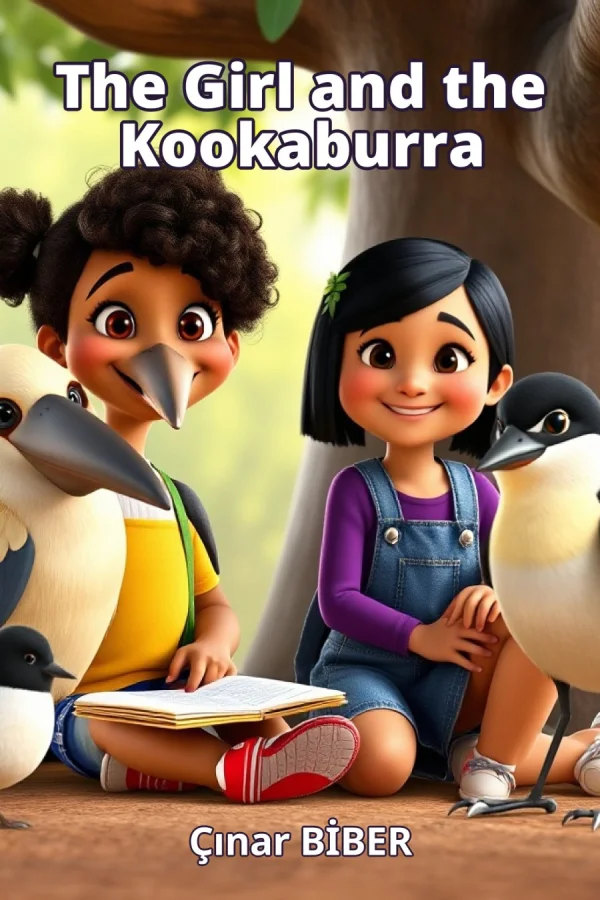
The Girl and the Kookaburra
Çınar BİBER
- Category Children's Fairy Tales
- Format PDF
- Size 12.6 MB
- Added 30.10.2026
- Views 2
Maya lives in a small house with a big garden in Australia, and every morning she wakes to the sound of birds singing outside her window. Wearing her yellow t-shirt and carrying her green canvas satchel, she settles under an old gum tree with a notebook and pencil and decides to find out where each call comes from. A cheeky kookaburra laughs from the left, a willie wagtail sings from the fence, a magpie carols from the roof, rainbow lorikeets screech overhead, and smaller voices like a wren and a honeyeater join in from the flower bushes and the bottlebrush tree. Piece by piece, Maya turns these sounds into a sound map, drawing each bird and marking its call.
As she listens more closely, Maya notices that the birds are not simply making noise. The kookaburra's laugh is like a drumbeat, the wagtail's song like a fast dance, the magpie's carol like a tune, and the dove's soft coo calm and gentle. She begins to hear the garden as an orchestra with no instruments, and when her best friend Rosie arrives, the two of them sit together with closed eyes and share the concert. Maya shows Rosie how to draw her own sound map, and soon other friends gather to listen and make maps of their own.
The story follows a curious, observant child who turns a familiar garden into a place of discovery through patience and attention. It introduces young readers to Australian birds and their distinct voices, and it shows how listening carefully can reveal pattern, music, and beauty in ordinary surroundings. Told in simple, warm language, it suits children at the picture-book and early-reader stage, as well as parents and teachers looking for a gentle story about curiosity, friendship, and the natural world.
Read the Tale
If the PDF does not appear, open it in a new tab.
A Passage from the Tale
The Girl and the Kookaburra Çınar BİBER
Maya lived in a small house with a big garden in Australia. Every morning, she woke up to the sound of birds singing outside her window. She loved to listen to their chirps, whistles, and warbles. Maya had warm brown skin, curly dark hair in two puffy buns, and a bright curious smile. She always wore her yellow t-shirt with a small bird print and carried her green canvas satchel everywhere. 1
One sunny morning, Maya sat under a gum tree and closed her eyes. She heard a soft tweet-tweet from a little brown bird. Then a loud laugh burst from a tall tree. 'Ha-ha-ha-ha!' It was a kookaburra! Maya giggled. She had heard kookaburras before, but this one sounded especially cheeky. She decided to find out where each bird call came from. 2
Maya took out her notebook and a pencil from her green satchel. She drew a big circle for the garden and a little house for her home. Then she heard the kookaburra again. 'Ha-haha!' It came from the old gum tree on the left. She drew a small bird and wrote 'kookaburra' next to it. 'This will be my sound map,' she said. 3
Maya listened carefully. A willie wagtail sang from the fence. Its call was quick and lively: 'Sweet-sweet-sweet!' The little black and white bird wagged its long tail up and down. Maya drew a tiny bird on the fence in her map. She marked it with a wavy line for the wagging tail. The willie wagtail kept singing, as if to say, 'Did you get that?' 4
Next, Maya heard a magpie caroling from the roof. Its song was rich and bubbly, like water trickling over stones. She drew a magpie on the roof and added musical notes. Then a flock of rainbow lorikeets screeched overhead. Their calls were loud and excited. Maya drew them flying across the top of her map, with bright squiggles for their noisy chatter. 5
Maya walked slowly around the garden, stopping to listen. Near the flower bushes, she heard a soft 'cheep-cheep' from a tiny wren. She drew a little wren hidden in the flowers. Then a honeyeater called 'chip-chip' from the bottlebrush tree. Maya added its call to her map. Her map was getting full of birds and sounds! 6
As she listened, Maya noticed something. The birds were not just making noise. They were making music! The kookaburra's laugh was like a drumbeat. The willie wagtail's song was like a fast dance. The magpie's carol was like a lovely tune. 'It's like an orchestra,' Maya whispered. 'But with no instruments!' 7
Maya sat very still under the gum tree. She wanted to hear every sound. The kookaburra laughed again, and this time Maya laughed too. 'Ha-ha-ha!' she copied. The kookaburra tilted its head and laughed even louder. It seemed to like her. Maya drew a big laughing kookaburra in the middle of her map, with its beak wide open. 8
Then Maya heard a new sound. It was a soft, low coo from a dove. She looked up and saw the dove sitting on the telephone wire. Its call was gentle and calm. Maya drew the dove and wrote 'coo-coo' next to it. She realized that every bird had its own special voice. Some were loud, some were soft, but all were beautiful. 9
Maya looked at her sound map. It was covered with drawings of birds and their calls. She had marked where each sound came from. But the map was more than just pictures. It was like a piece of music you could see. 'Nature has its own music,' she said. 'And I can hear it everywhere!' 10
Just then, Maya's best friend Rosie came over. Rosie had a short black bob and a leaf hair clip. She saw Maya's map and her eyes went wide. 'Wow! What is that?' she asked. Maya explained how she had drawn all the bird calls. 'Can you hear them too?' Maya asked. Rosie listened. 'I hear the kookaburra!' she said with a grin. 11
Maya and Rosie sat together under the gum tree. They closed their eyes and listened. The kookaburra laughed. The willie wagtail sang. The magpie caroled. The lorikeets screeched. It was a wonderful bird concert! Rosie said, 'It's like the birds are playing just for us.' Maya nodded. 'And we don't need any instruments to join in.' 12
Maya showed Rosie how to draw her own sound map. Rosie drew a kookaburra on a branch and a willie wagtail on the fence. They laughed as they tried to copy the bird calls. 'Haha-ha!' said Maya. 'Tweet-tweet!' said Rosie. The birds seemed to answer them. It was a game of music and friendship. 13
Soon, other friends came to see what Maya and Rosie were doing. They all wanted to listen to the bird music. Maya shared her sound map with them. 'You can make your own maps too,' she said. 'Just listen and draw.' The children spread out in the garden, each with a notebook and pencil, listening to the birds. 14
The garden was filled with the sounds of birds and children. Everyone was smiling. Maya felt happy. She had discovered that nature's music was all around her. And the kookaburra, with its cheeky laugh, had started it all. 'Thank you, kookaburra,' she whispered.
This is a preview taken from the tale (about 899 words). To continue, read the tale or download the PDF.
Tale Details
- Tale
- The Girl and the Kookaburra
- Author
- Çınar BİBER
- Category
- Children's Fairy Tales
- Language
- English
- Format
- PDF · 12.6 MB
- Pages
- 18
- Words
- about 962
- Published
- Masalcı Baba · 30.10.2026
- Access
- Free to read and download; for personal use only, all rights belong to the author.
Frequently Asked Questions
Is the PDF of The Girl and the Kookaburra free?
Yes. The Girl and the Kookaburra can be read and downloaded for free on this site; no sign-up or payment is required.
How many pages is The Girl and the Kookaburra?
The Girl and the Kookaburra has 18 pages and about 962 words.
Where can I read The Girl and the Kookaburra?
It opens inside your browser on phones, tablets and computers; you can also download the PDF and open it offline.
Who wrote The Girl and the Kookaburra?
The author of The Girl and the Kookaburra is Çınar BİBER; the tale is in the Children's Fairy Tales category.